
AI in construction ROI is starting to sound less like hype and more like a real line item you can point to on a job cost report. If you are a contractor, subcontractor, or trades pro trying to decide if now is the time to lean into AI, you are not alone. AI in construction ROI comes down to a simple question most field leaders ask themselves every day: Is this saving my people time, cutting risk, and putting money back into the business, or not?
Right now, the answer from early adopters looks like a pretty strong yes. A recent Building the Future survey of over 1,000 AEC pros worldwide found that early AI users are regaining 500 to 1,000 hours per year on critical work. Those are hours pulled from takeoffs, coordination, RFIs, submittals, and rework that would normally eat up already-tight margins.
The big story here is simple. A small but growing group of builders is moving past the buzz and treating AI like a regular part of the toolset, right beside lasers, tablets, and layout robots. The rest of the industry is still hesitating because of genuine concerns about data, skills, and change fatigue, even though the math is already pointing in one direction.
Strengthening Hawaii’s Workforce Through Diverse Trade Training
ABC Hawaii Chapter offers Five Trades, Carpentry, Electrical, Plumbing, Painter, and Roofing. We continually seek additional crafts and trades which are needed to maintain our Hawaii’s workforce.
If you are eyeing AI tools and still dragging your feet, it is probably not because you do not see any benefit. You have heard the stories about faster takeoffs, fewer change orders, and cleaner documentation. However, several very real roadblocks keep coming up across commercial and industrial jobs of all sizes.
First, data security and privacy are the top concerns named in the Bluebeam Building the Future report. Many firms worry that drawings, estimates, or proprietary processes might be exposed if they move workflows into cloud-based or AI-assisted tools. This fear is valid in an industry where your bid strategy and intellectual property are your main competitive advantages.
Contractors often fear that their historical cost data could leak to competitors or be used to train a model that helps another firm beat them. This hesitation slows down adoption significantly. Leaders need to feel confident that their hard-earned data remains secure before approving new software expenses.
Second, almost one in five firms say they lack the digital skills needed to use modern platforms effectively. Nearly a quarter feel the tech is moving faster than their teams can keep up. This skills gap is widening as the current workforce ages and retires.
On top of that, two-thirds of companies are spending less than ten percent of their tech budget on training. That mismatch shows up fast in daily operations. You might buy software that can reduce clashes or speed submittals, but actual adoption remains weak across the project team.
Field leaders do not have time for one more login or a complicated interface. Office staff bounce between systems that do not talk to each other. As a result, the potential ROI of AI in construction gets buried under frustration and wasted subscription costs.
While many are stuck on the sidelines, a growing set of builders has already moved ahead and started to see clear returns. The gains tend to fall into a few buckets that matter to almost any merit shop contractor trying to grow a stable workforce and protect margins.
| AI Benefit Area | Common Results Reported |
|---|---|
| Time savings on admin tasks | 500 to 1,000 hours reclaimed per year on early adopter teams |
| Estimating and takeoffs | Faster material lists and higher bid volume with the same staff |
| Coordination and clash detection | Fewer field conflicts and lower rework costs |
| Safety and fleet performance | Crash rates cut by more than half in some AI-monitored fleets |
| Workforce recruitment and retention | Less paperwork and burnout, more time on meaningful craft work |
Take safety as one clear example. A recent Samsara construction safety report, covering 2,600 fleets, found that AI-powered dashcams and driver coaching helped reduce crashes and harsh events by as much as 73%. That is not theory or speculation.
That statistic represents fewer people hurt, fewer trucks in the shop, and fewer phone calls from an attorney. Preventing accidents also keeps insurance premiums stable, which directly impacts your overhead. A safer fleet means you can bid more aggressively without worrying about rising coverage costs.
Another practical case shows up in estimating. Home Depot rolled out AI-powered blueprint takeoffs for residential pros that can turn plan sets into material lists and pricing much faster than old-school manual takeoffs. This change transforms an estimator’s daily life.
For a busy estimator chasing a long bid list, those hours go straight back into more bids and stronger hit rates rather than zooming and scrolling all night. Instead of counting fixtures one by one, they can focus on analyzing scope gaps and identifying value-engineering opportunities. This shift allows the same team to handle more volume without burnout.
If you’re thinking about what comes after high school, compare your options. ABC Hawaii’s Trade School offers a hands-on path to a real career—without the student debt.
If you work or own the company, you probably do not care what the technology is called. You care about whether it pays for itself. AI in construction ROI tends to break down into a few simple buckets that appear in any profit-and-loss statement or project forecast.
The easiest way to start calculating value is with hours. The Bluebeam survey reports that nearly half of AI early adopters gain back 500 to 1,000 hours per year across key tasks. Those hours usually come from paperwork-heavy work such as RFIs, document control, drawing comparison, or form building.
If you put even a mid-range rate on that time, the numbers get really pretty fast. Suppose a project engineer or superintendent costs the business fifty dollars per hour loaded. Saving 600 hours per year works out to 30,000 dollars’ worth of capacity you can shift elsewhere.
You can move that capacity to higher-value tasks, stronger field support, or another job in the backlog. This creates a force multiplier, enabling your existing staff to manage more work without added stress. The ROI here is immediate and measurable on the payroll ledger.
Rework is where many contractors quietly bleed. Studies across construction show rework often eats up five to twenty percent of project costs, depending on how you count. AI tools that spot drawing changes, flag conflicts, or track field data can chip away at that waste.
For example, digital form builders with AI support are now turning handwritten, inconsistent paperwork into clean, structured data in seconds. Tools like this let field teams capture real conditions and issues in a standard format that office teams can actually use. Better information means fewer mistakes that lead to ripping and tearing later.
Catching a clash in a digital model costs pennies compared to moving a duct run in the field. When AI helps identify these issues during preconstruction, the savings are massive. You avoid the material cost, the labor to redo the work, and the schedule hit that follows.
Another significant driver of AI in construction ROI is cycle time. The longer it takes to get answers on RFIs, change orders, or inspections, the more time and money leak out of the schedule. AI systems that can route, summarize, or auto-fill common responses shave hours or days off those loops.
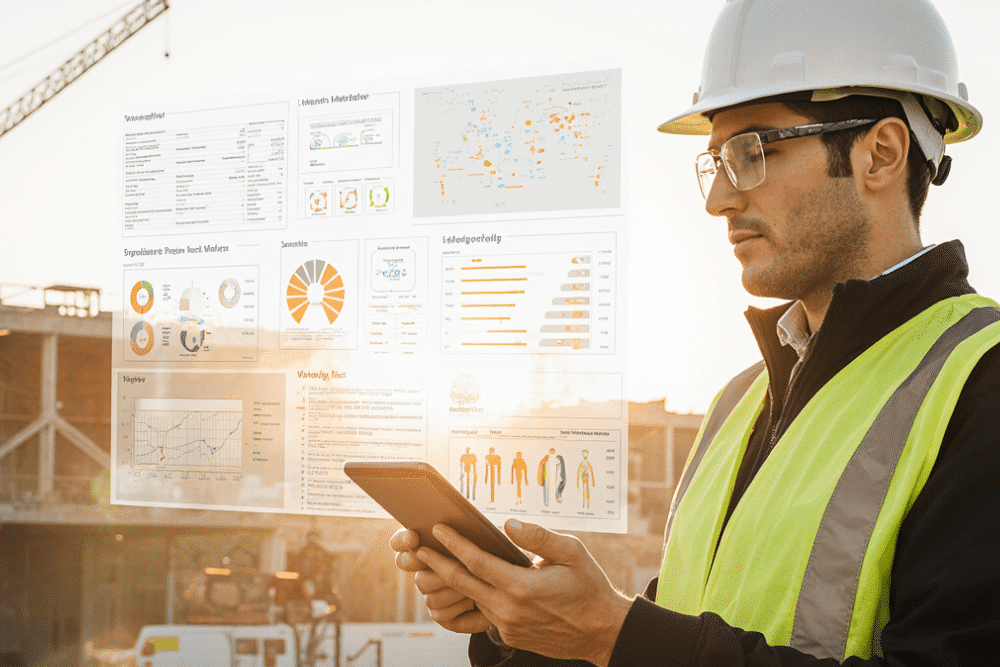
Imagine a job where RFIs are drafted in minutes based on structured site data. Think about long email threads getting summarized instantly so the project team can act quickly. Consider a dashboard that consolidates risk signals from safety, quality, and schedule into a single view.
Faster decisions almost always lead to tighter schedules and smoother cash flow. When answers arrive faster, crews keep moving. This momentum protects the project’s profit margin from the slow erosion of delays.
Insurance premiums, EMR scores, and brand reputation all rise or fall with safety performance. As the Samsara report shows, AI-powered video, telematics, and coaching can cut risky behavior long before an accident occurs. Fewer incidents mean less downtime and better standing with owners and carriers.
Over time, that shows up as reduced premiums, stronger negotiating power, and more chances to bid on extensive or public work where safety records carry heavy weight in prequalification. The payback might not feel as fast as shaving hours off takeoffs, but it adds up across years. A lower EMR score can be the deciding factor in winning a significant contract.
You do not need to boil the ocean or turn your company into a tech firm overnight. The firms seeing good returns tend to start with very focused use cases that connect clearly to field work, cash flow, and risk. A solid overview of AI in construction use cases is laid out in a ClickUp guide that walks through practical tools for planning, site management, and more.
AI-driven takeoff and estimating tools scan plans, identify assemblies, and generate material lists in a fraction of the time it takes manual processes. Early adopters use this to respond to more bids without growing the estimating staff at the same rate. This scalability is vital in a market where bid volume fluctuates.
The payback shows up as a higher volume of qualified bids, fewer human errors in counts, and more time left for value engineering or scope review, rather than chasing page numbers. For trade contractors living and dying on tight precon timelines, this alone can be worth the pilot. Being able to trust your counts allows you to tighten your bid without fear of losing money.
Document control and coordination sit at the center of many AI trials today. Systems that can compare drawing sets, detect changes, auto-link RFIs to the proper sheets, or predict schedule conflicts give teams better visibility across design, construction, and operations. This clarity prevents the confusion that typically leads to disputes.
The Building the Future report notes that almost 40 percent of firms still struggle with collaboration across the full project lifecycle because teams operate in silos. AI-enhanced platforms push back against those silos by keeping the correct information in front of the right people at the right time. When everyone builds from the most current set of plans, efficiency naturally improves.
Construction fleets are fertile ground for fast AI wins. Smart dash cams can spot risky driving, phone use, or harsh events and send coaching cues right away. Machine telematics and AI analysis reveal patterns that hint at unsafe operations long before a breakdown or injury occurs.
Fleet leaders who use this data report tighter fuel usage, fewer unplanned stops, and lower repair costs, in addition to the safety gains mentioned earlier. Reducing idle time alone can save thousands of dollars across a large fleet. Those dollars fall directly to the bottom line in many self-perform and heavy civil outfits.
At ABC Hawaii, we believe safety is the cornerstone of a successful construction industry. That’s why we offer a diverse range of safety training programs tailored to meet the unique needs of our members. With both online and in-person options, our training provides the flexibility to suit any schedule or learning preference.
One thread keeps coming up across all the studies and case stories on AI and broader construction tech. Tools on their own do not fix broken workflows or cultures. Usman Shuja from Bluebeam puts it clearly: success requires training and an integrated approach that links people, workflows, and project phases.
Yet most firms are starving for training. Two-thirds invest less than 10% of their tech budget in building skills. That gap helps explain why a crew might use an expensive platform as a glorified PDF viewer instead of an actual collaboration space.
It also explains why supervisors snap back to text messages and whiteboards the second pressure ramps up. Without confidence in the tool, people revert to what they know. This kills the efficiency gains you paid for.
If you want strong AI ROI in construction, treat training as part of the capital expense rather than a nice-to-have. Build time into project plans and job cost codes for coaching, sandbox use, and support. This investment ensures the tool is actually used.
Partner your digital leads with seasoned field pros so the technology grows out of real work rather than being dropped on people from above. When a superintendent sees how a tool makes their day easier, adoption happens naturally. That is when the real returns start to accumulate.
Whether you are a project manager at a merit shop contractor or an owner weighing a bigger digital strategy, you need a simple way to tell if AI will pay back the investment. A clear business case does not need to be fancy. It just needs to tie to your actual jobs, crews, and margins.
Start with something your teams often complain about. Maybe it is slow RFIs, constant drawing confusion, heavy manual data entry, or long evenings of takeoffs. The more painful and repeatable the issue, the easier it will be to track change.
Write down what that pain costs today. How many hours does it soak up per week? What does that time cost in labor?
Are there change orders or rework items you can link to this pain point? Putting a dollar figure on the problem is the first step to solving it. This establishes your baseline for success.
Next, find a focused AI tool or feature that hits that specific issue. Use resources like the AI in construction use case guide to see what is already working in the market, rather than guessing or chasing shiny objects. Look for tools that integrate with your existing software stack.
Talk with vendors, peer contractors, and trade associations to see what realistic gains look like. Do not just trust the sales brochure. Ask for references from companies similar to yours.
For example, if other users see a twenty percent reduction in time on submittal review, apply a conservative version of that number to your own baseline. This gives you a realistic target. It helps you set expectations with your leadership team.
Then pick a small but meaningful pilot—maybe one division, one region, or one large job where leadership is bought in. Make sure crews know the pilot goals and have simple ways to log time and issues before and after.
Track the metrics that matter to you. Those may be hours spent, number of RFIs, response times, change order dollars, safety incidents, or fuel use. Put those results in a short table and compare them with the tool’s cost and the time spent on training.
At the end of the pilot, your numbers should give you a grounded view of AI in construction ROI in your setting. If the returns are clear and adoption feels strong, expand. If the value is mixed, tune workflows or switch vendors.
If there is little to show and teams hate it, cut your losses and move on. The goal is not to win every bet. The goal is to learn quickly, fail cheaply, and scale what really works for your type of work and your crews.
Join ABC Hawaii
We help you win work, enhance safety, and increase profits. Join our community to access elite training and advocate for free enterprise. Elevate your impact in the construction industry today!
One angle that does not get enough airtime in AI discussions is how these tools tie into workforce pipelines, apprenticeship programs, and free enterprise values that groups like ABC and similar associations champion. Construction is facing a long-term labor squeeze. The industry will not solve it by simply squeezing more overtime out of aging crews.
Early AI adopters see technology as a way to make field careers more attractive, not less. By stripping out low-value paperwork, double entry, and avoidable rework, you create more room for hands-on learning and pride in craft. Apprentices get more time with foremen, actually teaching skills, and less time hunting old drawings.
That story matters for recruiting younger workers who grew up with phones and expect modern tools at work. They do not want to work for a company that relies on fax machines and paper triplicate forms. Showing them a high-tech workflow proves you are building for the future.
It also helps keep mid-career pros in the industry longer because they are not worn down by preventable chaos day after day. Reducing frustration keeps good people on your payroll. This stability supports the merit shop philosophy of rewarding performance and efficiency.
You might still be wondering how to move from ideas on a page into traction on your jobs. The good news is that you do not have to turn your entire operation upside down. You need a calm, phased plan that respects field reality.
If you do these basic things, you move from theory to practice. You let the numbers prove whether AI deserves a lasting place in your toolbox. This approach minimizes risk while opening the door to innovation.
At this point, AI is less a question of science fiction and more a question of basic business discipline. Early adopters across AEC have already shown that you can reclaim hundreds of hours a year, lower crash and rework rates, and improve coordination across the entire project lifecycle. For contractors, subs, tradespeople, and industry leaders who care about stable growth and strong careers, the better question is how and where to tap into AI in construction ROI, not whether it exists at all.
Your edge will come from starting small, staying honest about the math, and treating training and change management as first-class work, not an afterthought. If you do that, AI shifts from buzzword to quiet competitive advantage baked into your jobs, your people, and your margins. Over the next few years, the gap between companies that lean in with that mindset and those that stand still will keep widening, job after job, bid after bid.